Appearance
2. Where Liquidity Lives
AMMs, order books, and the firms that replaced passive LPs.
Cold open
In the second quarter of 2024, Phoenix earned $3.7 million in trading fees on Solana. That was its peak. Phoenix was the serious version of an on-chain central limit order book: built by Ellipsis Labs, run by a small team with former Jane Street and Jump Trading engineers, and backed by a clear thesis. Automated market makers were a temporary fix. Eventually, on-chain spot markets would look more like NASDAQ than a vending machine.
By the first quarter of 2026, Phoenix's quarterly fee revenue had fallen to $68,604, about 54× below the peak. The same team renamed the venue Phoenix Legacy and moved on to perpetuals.[1]
Why the retail version of "providing liquidity" no longer means what it did in 2021?
What this chapter answers
- What is liquidity, in plain terms, and why doesn't a market just work without it?
- How do automated market makers and order books differ in dollars, not just in design?
- What does it actually look like to be a passive liquidity provider, and why did the job turn out worse than the early pitch promised?
- Why have aggregators and solver markets become the retail front door, and what do they keep for themselves?
- Why did Solana converge on private prop-AMMs routed through Jupiter, Hyperliquid on a native order book, and Ethereum on both?
The setup
A market needs two things: someone who wants to buy, and someone ready to sell at a price the buyer will accept. Liquidity is the second part. It is the market's supply of "yes, now."
In a textbook financial market, liquidity lives in an order book. Bids sit on one side, asks sit on the other, and the best bid and best ask form the inside market. A trade happens when an incoming order crosses that spread. NASDAQ works this way. So does the New York Stock Exchange. So does, in a different form, the Chicago Mercantile Exchange's pit-and-screen hybrid.
On-chain markets ran into a problem with that model. Every order-book action — place, cancel, modify — has to be processed by the chain. In 2017, that meant slow and expensive. The order book wanted millisecond reflexes. The chain moved at human speed.
So DeFi tried a different design. An automated market maker (AMM) replaces the order book with a pool of paired assets — say, ETH and USDC — and a formula that prices swaps against the pool's balances. There are no resting orders. There is no spread in the normal order-book sense. There is a curve, an inventory, and a fee paid to whoever supplied the assets. The first AMM that mattered was Uniswap V2 in 2020; the constant-product formula it popularised, x · y = k, is now the default model for most on-chain venues that are not Hyperliquid.[2]
A second layer sits above both designs. Aggregators — Jupiter on Solana, 1inch and Paraswap on Ethereum — read prices across many venues and split a user's swap across the route with the lowest slippage. A trader using an aggregator is not choosing one pool. The aggregator chooses.
Then there are solvers. On Ethereum, systems such as CoW Swap, UniswapX, and 1inch Fusion let a user state the outcome they want: "get me at least X ETH for my Y USDC." Professional market-making firms compete to fill that intent. The solver decides where the liquidity comes from. The user sees the final price.
The worked example
Bob has $50,000 he is willing to put into the ETH/USDC pair. A colleague tells him the Uniswap V3 pool at the lowest fee tier, 5 basis points, is the highest-volume venue for that pair on-chain. The interface tells him that liquidity providers earn a share of the pool's trading fees, proportional to their deposits.
He chooses the simplest setting: a "full-range" position. His $50,000 sits across the entire price range the pool can quote. He converts half to ETH, signs two transactions, and becomes an LP. A fee counter appears. It starts ticking upward in fractions of a cent.
The trade-off is less visible. Bob earns fees when swaps cross his liquidity. He also gives up inventory to whoever trades against the pool. On the highest-volume pool in DeFi, that counterparty is usually an aggregator's route or a market maker hedging a position elsewhere. They often know more about the current ETH price than the pool does. The pool catches up after the swap. Bob does not get paid for that catch-up.
For years, DeFi called this impermanent loss or some academic work calling the same problem Loss-Versus-Rebalancing.
Where the losses hide
The AMM curve, and the loss the LP doesn't see
Its formula is straightforward. In a constant-product pool, the product of the two reserves stays fixed. If the pool holds 1,000 ETH and 4,000,000 USDC, then 1,000 × 4,000,000 = 4,000,000,000 = k. The quoted price — 4,000 USDC per ETH at that moment — comes from the ratio of the two reserves. It is not anyone's view of ETH's true value.
When a trader sells ETH into the pool, the pool's ETH balance rises, its USDC balance falls, and the quoted price for the next trade drops. How much it drops depends on the swap size relative to the pool's depth.
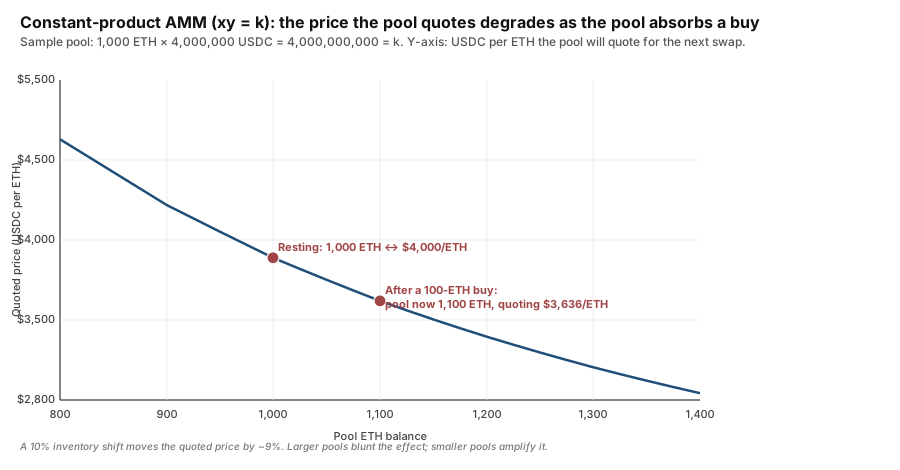
The curve is why AMMs work. It is also why LPs get picked off. A pool deep enough that one trader's $10,000 swap barely moves the price is rare. A pool shallow enough that $10,000 moves the price by several percent is common. The fee tier — 5 bps, 30 bps, 100 bps, depending on the pair — is the LP's payment for hosting that curve.
Uniswap V3, launched in 2021, tried to make passive LPs more capital-efficient with concentrated liquidity. Instead of spreading deposits across every possible price, V3 lets the LP choose a range. If the price stays inside that range, the LP earns more fees than a V2-style full-range position. If the price leaves the range, the position stops earning until the price comes back. That works for stablecoin pairs, where the price barely moves. It is harder for volatile pairs, because the LP has to guess the future range. Being wrong by a few percent can mean earning nothing.
The results were worse than the pitch. The earliest broad measurement, by Topaze Blue and Bancor, looked at seventeen V3 pools that represented about 43% of V3 TVL at the time. LPs earned $199.3 million in fees and absorbed $260.1 million in impermanent loss. Net, they were about $60.8 million worse off than if they had simply held the assets. About 49.5% of measured LPs lost money after impermanent loss.[3] No one has published a comprehensive 2025-2026 rerun of that study. The finding has not been refuted; it has just gone stale.[4]
Uniswap Labs published the most useful single-pool result in 2023. Across the period studied, passive V3 LPs earned about 54% more fees than V2 LPs on average. But in the ETH/USDC 5-bps tier, the highest-volume tier, passive V3 LPs underperformed V2 by 68%.[5] The most-traded pool was the hardest place to be passive, because that is where the counterparty most often knows more than the pool.
Loss-Versus-Rebalancing, developed by Milionis, Moallemi, Roughgarden, and Zhang, makes the comparison harsher. The LP is not only competing with someone who held ETH and USDC. The LP is competing with someone who would have continuously rebalanced the same position against a centralised exchange. Under that framework, an ETH/USDC pool with 5% daily price volatility — typical for early-2026 ETH — loses about 3.125 basis points per day, or about 11% annualised, to arbitrageurs who keep the pool's price aligned with the broader market. Fees have to cover that loss. Often they do not.[6]
For Bob, the month looks roughly like this: $350 in fees collected, $475 lost to LVR, net negative $125 on his $50,000 position. That is about a 3% annualised drag. Small in one month. Real over a year. Very real across thousands of Bobs.
The order book, and why Hyperliquid is the exception
A central limit order book has no pool and no curve. It has bids — prices where someone is willing to buy, with size attached — and asks on the other side. The best bid and best ask form the inside market. The difference is the spread. A trade happens when an incoming order crosses it.
The catch is that someone has to post those bids and asks. These are market makers. Without them, the book is empty.
Meet the Market Maker
Job: Post two-sided liquidity to a venue and capture the bid-ask spread.
How they earn: From the spread between the price where they fill an incoming buy order and the price where they fill an incoming sell order. On many venues, they also earn maker rebates for resting liquidity. Solver-style market makers earn the difference between the price they give the user and the price where they hedge, often on Binance.
How they spend: Mostly on inventory risk. Every fill leaves them holding a position they did not ask for; until they hedge it somewhere else, the next price move can hurt them. They also spend on speed: co-located servers, dedicated network routes, and engineers who tune quoting algorithms. The moat is increasingly the relationship with the venue itself: privileged flow, lower fees, faster cancel paths.
TradFi analogue: A market-making desk at Citadel Securities, Jane Street, Optiver, or DRW.
For nearly a decade, on-chain order books could not make the math work. Every order update was a transaction. Every transaction needed validation. Every validation cost gas. A market maker on a centralised exchange can place and cancel tens of thousands of orders per second as prices move. The same firm on an Ethereum-based order book in 2021 could place a few orders per minute and pay orders of magnitude more than the transaction fees to cancel them on time. Leave stale quotes up, and faster traders lift them. Cancel stale quotes, and the network gets paid. Either way, the market maker loses.
Hyperliquid is the place where that math works out. It runs its own consensus, HyperBFT, with about 200-millisecond end-to-end latency for a co-located client and a 99th percentile around 900 milliseconds. It has no public mempool, so a market maker's cancel can reach the matching engine before an opportunistic taker sees and lifts the stale quote. Matching happens inside consensus, not in a smart contract called by each transaction.[7]
By early 2026, Hyperliquid's disclosed top-of-book spread on the BTC perpetual contract was about $1, versus roughly $5.50 on Binance. Hyperliquid's founder shared the numbers in January, along with a depth comparison showing more resting size at one basis point from the mid-price than Binance.[8]
The market makers are not mystery accounts. Wintermute quotes across seventy-six Hyperliquid markets with roughly $199 million in active resting notional. Bitwise's April 2026 amendment to its proposed Hyperliquid ETF S-1 names Wintermute and Flow Traders' digital-asset arm Flowdesk as approved trading counterparties on the venue.[9] These firms are not new to crypto. They have been market making on centralised exchanges for years. Hyperliquid is the on-chain venue where that model first worked at scale.
At the same time, Phoenix lost the spot market. Solana gas is far cheaper than Ethereum gas, but cheap was not enough. Spot order books did not generate enough flow to pay the market makers who would have had to keep them alive. Retail flow had moved elsewhere.
Aggregators, solvers, and the retail interface that replaced the pool
Alice wants to swap $10,000 of USDC for SOL. She is not going to open the Raydium app, then the Orca app, then the Meteora app, then a Phoenix order book, then a Manifest order book, compare prices, and split her trade. She is going to open Jupiter, type the amount, and click swap.
Jupiter splits her order across three pools — sixty percent to HumidiFi, twenty-five to Orca, fifteen to Meteora — because that route gives her the best blended price after slippage. Each leg is its own swap. Each pool returns its own quote. Alice gets closer to the centralised-exchange price for SOL than any single pool would have offered. Jupiter earns a small routing fee embedded in the slippage. The pools do not choose Alice. Jupiter chooses the pools.
By Q1 2026, Jupiter had about 93.6% of Solana aggregator-routed flow, after recovering the share it briefly lost to Titan and DFlow in late 2025.[10] More than 70% of all Solana DEX volume now goes through aggregators rather than directly to pools.[11] The aggregator has become the trading interface. The pool has become inventory.
Ethereum's version took a different route. CoW Swap, UniswapX, and 1inch Fusion are solver markets. A user states an intent. Market-making firms compete to fill it from inventory they choose. A 2025 paper by Khakhar et al. found that more than 85% of CoW Swap solver liquidity came from AMM pools, making the solver a smarter router. More than 85% of UniswapX solver liquidity came from professional market-maker inventory, making the solver closer to a private market maker. Two firms, SCP and Wintermute, accounted for more than 90% of UniswapX volume.[12] By July 2025, CoW Swap had crossed $9 billion in monthly volume, and Barter, its largest solver, had reached 28% solver share and was targeting more than half.[13]
Solana aggregators and Ethereum solvers look different under the hood, but they point the market in the same direction. The retail trader no longer goes straight to the pool. The retail trader sends an intent to an intermediary. The intermediary decides whose inventory gets used. The pool is no longer the front of the market. It is the back-stop the intermediary trades against when its own inventory or routing is not enough.
The prop-AMM displacement
Solana shows the shift most clearly. By early 2026, three programs — HumidiFi, SolFi, and Tessera — together accounted for more than half of Solana spot DEX volume. HumidiFi alone held roughly 65% of that segment and got more than 95% of its volume through aggregator routing.[14]
These are not public AMMs in the Uniswap sense. They do not publish their inventory. They do not take deposits from passive LPs. They do not quote a curve outside observers can compute. They are prop-AMMs: private market-making operations with closed pricing logic and on-chain settlement.
The operators are starting to come into view. HumidiFi has been reported to be run by Temporal, the same firm that runs Solana's largest transaction landing service / private RPC business.[15] SolFi is run by Ellipsis Labs, the team behind Phoenix. Tessera makes up a majority of the execution flow routed through Titan, which points to the same pattern: the pricing layer and the routing layer moving closer together.
The core change is who absorbs adverse selection. In a public AMM, the passive LP absorbs it blindly. The pool does not know whether the next trader is informed or uninformed, so the LP subsidises both. In a prop-AMM, the operator is the LP. It can quote wider when it suspects informed flow, tighter when it sees uninformed retail, and keep the spread either way. The public LP role disappears because a market-making firm has internalised the job and kept the economics.
A passive LP in a constant-product pool cannot tell the difference between an informed and an uninformed counterparty. A market-making firm can, and prices accordingly. The winning design puts the pricing decision with the participant best equipped to make it. On Solana, that participant turned out not to be a DAO-governed public pool. It turned out to be a small, private firm whose code no outsider has seen.
How this plays out on each chain
On Solana, the retail trader usually starts with Jupiter. Jupiter routes most of its flow into prop-AMMs — HumidiFi, SolFi, Tessera — that supply more than half of spot volume. Public AMMs such as Meteora, Raydium, and Orca still matter, with Q1 2026 protocol revenues of $11.4 million, $5.6 million, and $1.8 million respectively.[16] The spot CLOB experiment has mostly ended. Phoenix has been renamed. OpenBook is small. Manifest, at $3.9 billion in 30-day volume, is the only on-chain spot CLOB above noise, and it is still less than 2% of Solana's $284.5 billion Q1 2026 DEX spot volume.[16:1]
On Hyperliquid, the native CLOB works because speed and privacy make professional market making viable. Median end-to-end latency is about 200 milliseconds for a co-located client, and there is no public mempool. In April 2026, Hyperliquid handled about $177.66 billion in 30-day perpetuals volume, roughly 70% of on-chain perpetuals share. Spot volume was $3.1 billion, less than 2% of the perp number.[17] The protocol-owned HLP vault — which any depositor can fund, and which quotes against incoming flow and absorbs liquidation surplus — held $391 million in TVL with a reported lifetime CAGR of about 42% as of early 2025.[18] The CLOB works for perps because the protocol underwrites the worst flow itself. Market makers handle the rest.
On Ethereum and its L2s, both models survive. Uniswap V3 and V4 together hold roughly $2.9 billion in TVL and generated about $206 million in annualised fees in early 2026.[19] Above that pool layer, solver markets — UniswapX, CoW Swap, 1inch Fusion — have taken a growing share of retail flow. On L2s, AMM liquidity is fragmented across venues such as Aerodrome on Base. Solvers are there too, but direct AMM trading remains more important than it is on L1.
Who wins, who loses, why
Winners. The prop-AMM operators won the Solana spot market without opening their books to passive LPs: Temporal behind HumidiFi, Ellipsis Labs behind SolFi, and the firms behind Tessera. Ethereum's solver firms won the equivalent share of retail flow: SCP filling most of UniswapX, Wintermute filling much of UniswapX and seventy-six Hyperliquid markets, Barter targeting half of CoW. Jupiter won the Solana routing layer and monetised the slippage protection that a 93.6% aggregator share gives it. Hyperliquid's HLP captured value that would otherwise have gone to external market makers, then routed that value to validator economics and to the depositors funding the vault.
Losers. Passive LPs are the clearest case. The 2021-2022 work showed about half of LPs underperforming a simple hold after impermanent loss; LVR gives a sharper explanation for why. Bob's $50,000 position collected $350 in fees and lost about $475 to LVR, leaving him down $125 for the month. That is small once. It is not small repeated over a year, or across many LPs. Retail traders who still route directly to pools, without an aggregator, solver, or private fill, pay slippage the old way.
Is this bad? Not by itself. The designs that won handle adverse selection more cheaply, and adverse selection exists in every market. Prop-AMMs do the price discovery work AMMs were supposed to do, but with firms that can price risk better than early public pools could. Aggregators are real efficiency gains for traders who use them. The losers are not victims of misconduct. They are participants whose job changed while they were still doing it.
The passive LP who deposited in 2021 was promised one role and in 2026, that role is being done by a different kind of firm.
What changes when…
What changes when the prop-AMM filling your swap can see the swap before it executes — when the routing layer finding your best price is also, privately, watching everyone else's intent?
That visibility is what makes prop-AMMs more accurate than passive pools. It is also what makes another actor possible: the searcher. The mempool, and the privileged visibility it grants, is Chapter 3.
Footnotes and sources
Phoenix data drawn from DefiLlama's Phoenix protocol page, https://defillama.com/protocol/phoenix, accessed 2026-05-13. Q2 2024 quarterly revenue ≈$3.70M (peak); Q1 2026 quarterly revenue $68,604; cumulative lifetime spot volume $75 billion against cumulative lifetime revenue $14.54M (a ~1.9 bps realised-fee rate consistent with the venue's spread-and-rebate model). The Phoenix-to-perpetuals pivot is documented in Ellipsis Labs, Introducing Phoenix Perpetuals, https://www.ellipsislabs.xyz/blog-posts/introducing-phoenix-perpetuals, accessed 2026-05-13. ↩︎
The original Uniswap V2 design is documented in Uniswap, Uniswap V2 Core (2020), https://uniswap.org/whitepaper.pdf. The constant-product invariant
x · y = kpredates Uniswap as a theoretical construct (most prominently in Hanson's "logarithmic market scoring rule"), but Uniswap V2 is the AMM whose deployment defined the on-chain category. Accessed 2026-05-13. ↩︎Topaze Blue and Bancor, Impermanent Loss in Uniswap V3 (2021); coverage and summary at https://cryptoslate.com/new-report-shows-50-of-uniswap-v3-liquidity-providers-are-losing-money/. The study covered seventeen V3 pools representing approximately 43% of V3 TVL at the time of the analysis. Accessed 2026-05-13. ↩︎
A 2025 commentary from MEXC Research, circulating in secondary citations, places the share of V3 LPs in volatile pairs who lost money net of fees at 54.7% — directionally consistent with the 2021 result. The primary report URL is not publicly accessible; the figure is included here for context only. Accessed 2026-05-13. ↩︎
Uniswap Labs Research, When Uniswap v3 Returns More Fees for Passive LPs (2023), https://blog.uniswap.org/fee-returns. Period studied: September 2021 to March 2022. The 68% underperformance figure is specific to the ETH/USDC 5-bps tier; the +54% average is across all tiers and pools studied. Accessed 2026-05-13. ↩︎
Milionis, Moallemi, Roughgarden, Zhang, Automated Market Making and Loss-Versus-Rebalancing (2022 onward), https://anthonyleezhang.github.io/pdfs/lvr.pdf. The σ²/8 derivation gives the LVR rate per unit time; at 5% daily volatility the implied annualised LVR is approximately 11%, derived in the a16z summary at https://a16zcrypto.com/posts/article/lvr-quantifying-the-cost-of-providing-liquidity-to-automated-market-makers/. Bob's $350 / $475 / -$125 month is illustrative — derived from these aggregate parameters applied to a $50,000 full-range position at typical 5-bps-tier fee yields. The individual P&L for any specific LP depends on the realised volatility and the LP's range choices. Accessed 2026-05-13. ↩︎
Hyperliquid Documentation, Order book and consensus, https://hyperliquid.gitbook.io/hyperliquid-docs/hyperliquid-l1/order-book. HyperBFT block intervals and the lack of public mempool are documented in the same source. Accessed 2026-05-13. ↩︎
The top-of-book and depth comparison numbers were disclosed by Hyperliquid founder Jeff Yan on X in early January 2026, and reported in CCN's coverage, Hyperliquid Most Liquid Platform — Crypto CEO: How True Are the Claims?, https://www.ccn.com/news/crypto/hyperliquid-most-liquid-platform-crypto-ceo-how-true-claims/. The numbers are operator-disclosed rather than independently audited; the chapter cites them as such. Accessed 2026-05-13. ↩︎
Wintermute's Hyperliquid presence is described in CoinShares, Hyperliquid: the Xetra of digital finance? (Q1 2026), https://coinshares.com/us/insights/knowledge/hyperliquid-trading/: seventy-six markets, ~$199 million in resting notional, ~1,700 active orders as of January 2026. Wintermute and Flowdesk are named as approved trading counterparties in Bitwise's April 2026 amendment to its proposed Hyperliquid ETF S-1, reported in Crowdfund Insider, https://www.crowdfundinsider.com/2026/04/272856-bitwise-submits-latest-amendment-to-hyperliquid-etf-names-flowdesk-and-wintermute-as-trading-counterparties/. Accessed 2026-05-13. ↩︎
SolanaFloor, Jupiter Reclaims Dominance with 93.6% Market Share in Solana's Aggregator Landscape (Q1 2026), https://solanafloor.com/news/jupiter-reclaims-dominance-with-93-6-market-share-in-solana-s-aggregator-landscape. Jupiter's share dipped below 50% on one day in November 2025 when DFlow briefly led; Titan reached approximately 7% in March 2026. The 93.6% peak is the recent high-water mark. Accessed 2026-05-13. ↩︎
SolanaFloor, Over 70% of Solana DEX volume now routed through aggregators, https://solanafloor.com/news/the-rise-of-aggregators-in-solana-de-fi-over-70-of-dex-volume-now-routed-through-aggregators-reaching-a-7-month-high. Late 2025 / early 2026. Accessed 2026-05-13. ↩︎
Khakhar et al., Execution Welfare Across Solver-based DEXes, arXiv:2503.00738 (March 2025), https://arxiv.org/html/2503.00738v1. The 90% figure for SCP plus Wintermute on UniswapX, and the >85% AMM-sourced vs >85% PMM-sourced split between CoW and UniswapX, are both drawn from this paper. Accessed 2026-05-13. ↩︎
Blockworks, Barter buys rival solver codebase to expand CoW Swap dominance (September 2025), https://blockworks.co/news/barter-buys-rival-solver-codebase. CoW Swap's July 2025 monthly volume of more than $9 billion is the venue's all-time high to date. Accessed 2026-05-13. ↩︎
Blockworks Research, Solana DEX Winners: All About Order Flow (5 January 2026), https://app.blockworksresearch.com/unlocked/solana-dex-winners-all-about-order-flow; Helius Research, Solana's Proprietary AMM Revolution (mid-2025), https://www.helius.dev/blog/solanas-proprietary-amm-revolution. The >50% prop-AMM share is the Blockworks Q1 2026 figure; the >95% aggregator-sourced share for HumidiFi is the Helius mid-2025 number. Both are consistent with the trajectory the chapter describes. Accessed 2026-05-13. ↩︎
DL News, Temporal said to be behind Solana prop AMM HumidiFi, https://www.dlnews.com/articles/defi/temporal-said-to-be-behind-solana-prop-amm-humidifi/. The attribution is reported, not confirmed by either party. Accessed 2026-05-13. ↩︎
Pine Analytics, Meteora Q1 2026 Quarterly Report, https://pineanalytics.substack.com/p/meteora-q1-2026-quarterly-report. Q1 2026 protocol revenues: Meteora $11.4M, Raydium $5.6M, Orca $1.8M. Solana DEX spot volume Q1 2026: approximately $284.5 billion (down 17% quarter-on-quarter). Manifest 30-day spot volume drawn from DefiLlama, https://defillama.com/protocol/manifest-trade. Accessed 2026-05-13. ↩︎ ↩︎
Hyperliquid volume and fee figures from Yellow, Hyperliquid Owns 13% of All Perp Volume (April 2026), https://yellow.com/research/hyperliquid-perp-volume-dominance-how-2026, cross-checked against DefiLlama, https://defillama.com/protocol/hyperliquid. Accessed 2026-05-13. ↩︎
HLP TVL drawn from DefiLlama, https://defillama.com/protocol/hyperliquid-hlp; lifetime and trailing CAGR from independent analysis at Geronimo, A Risk & Return Analysis of Hyperliquid's HLP Vault (February 2025), https://medium.com/@RyskyGeronimo/a-risk-return-analysis-of-hyperliquids-hlp-vault-7c164cd00a0d. The lifetime CAGR of ~42% pre-dates 2026's lower volatility regime and almost certainly overstates the forward return profile. Accessed 2026-05-13. ↩︎
Uniswap V3 and V4 TVL and fee figures from DefiLlama's Uniswap V3 protocol page, https://defillama.com/protocol/uniswap-v3, accessed 2026-05-13. ↩︎